



Best Reusable Nappies Australia Buyers Guide
If you're on the hunt for the best reusable nappies in Australia, you're likely trying to juggle convenience, cost, and doing right by the planet. It’s a common dilemma! Many parents find their perfect fit with top-rated Aussie brands like Bare and Boho, Designer Bums, and Baby Beehinds, which are loved for their great fit, serious absorbency, and frankly, gorgeous designs.
Why Australian Parents Are Switching to Reusable Nappies
Standing in the nappy aisle, faced with a wall of plastic-wrapped disposables, can be a bit much. It's no surprise that a growing wave of Aussie families are turning their backs on single-use options and embracing modern cloth nappies. The motivation isn't just about being "green"—it's a smart decision for their wallets, their baby's health, and their peace of mind.
This guide isn't here to just skim the surface. We're diving deep into the real-world benefits to give you the confidence to choose a system that actually works for your lifestyle. Think of it as your practical, no-jargon roadmap to the world of reusables.
The Driving Forces Behind the Switch
Making the move to cloth is rarely about just one thing; it's usually a blend of personal values and practical perks. For most Australian parents, the decision boils down to a few key factors:
- Serious Long-Term Savings: Yes, there's an upfront cost. But when you do the maths, using reusables can save your family thousands of dollars over the nappy-wearing years of just one child.
- A Lighter Footprint: Billions—yes, billions—of disposable nappies hit Australian landfills every single year. Switching to reusables is one of the most impactful ways you can slash your household waste.
- Kinder to Baby’s Skin: Modern cloth nappies often use natural, breathable fabrics like bamboo and organic cotton. For little ones with sensitive skin, this can mean fewer instances of nappy rash and a much comfier bum.
A Growing Market Reflects Changing Values
This isn't just a fleeting trend. The shift towards reusables reflects a bigger change in what parents value today. While the entire Australian nappy market is valued at around AUD 1.81 billion in 2024, the demand for sustainable alternatives is growing stronger by the day.
Disposables still dominate, but reusable brands are carving out a significant space. This growth is fuelled by parents who are actively seeking out products that are both eco-friendly and made from skin-safe materials. If you're interested in the numbers, you can explore more about these market trends and projections to see where things are headed.
Choosing reusables is an investment in your baby's comfort, your family's budget, and the health of our planet. It’s a small change that makes a big difference.
Navigating the Different Types of Reusable Nappies
Diving into the world of modern cloth nappies can feel a bit like learning a new language. You’ll hear acronyms like AIO, AI2, and terms like "pockets" and "fitteds" thrown around, which can seem pretty confusing at first. But trust me, the concepts are much simpler than they sound.
Think of it like choosing a car. Some are all-in-one automatic models, perfect for a quick, easy drive. Others are more like a customisable 4WD, built for heavy-duty performance and ready for anything. Each type of reusable nappy serves a different purpose, and finding the right one is all about matching it to your family's needs, your lifestyle, and even our unique Aussie climate.
This section is your straightforward guide to the main styles you'll come across. We’ll break down what makes each one tick, helping you figure out which might be the best reusable nappies Australia has for your little one.
A Quick Look at Reusable Nappy Styles
To get started, here's a simple breakdown of the most common reusable nappy types. This table should help you quickly compare them and see which might be the best fit for your family's needs.
| Nappy Type | Ease of Use | Drying Time | Best For |
|---|---|---|---|
| All-in-One (AIO) | Easiest | Longest | Daycare, grandparents, quick changes |
| Pocket Nappy | Moderate | Fast | Customisable absorbency, day & night |
| Fitted Nappy | Two-step process | Longest | Overnight, heavy wetters, leak-proofing |
Each style has its moment to shine. An All-in-One might be your go-to for trips out, while a trusty Fitted nappy saves the day (or night!) when you need maximum absorbency. Now, let's look at them in more detail.
All-in-One Nappies: The Ultimate Convenience
The All-in-One (AIO) nappy is the closest you'll get to a disposable in the cloth world. True to its name, everything is built right in. The absorbent layers are sewn directly into the waterproof outer shell, meaning there are no separate parts to snap, fold, or stuff.
This makes them incredibly simple to use. You just put the nappy on your baby, and when it’s dirty, the entire thing goes straight into the wash. It’s this no-fuss approach that makes AIOs a firm favourite for daycare centres, grandparents, or anyone who just wants to keep things easy.
The trade-off for all that convenience? Drying time. Because all the layers are stitched together, they can take a lot longer to dry, which is a real factor during a humid Sydney summer or a drizzly Melbourne winter. They also tend to be one of the pricier options upfront.
Pocket Nappies: The Customisable Workhorse
Next are Pocket Nappies. Picture a waterproof shell with a soft, stay-dry lining on the inside. This design creates a "pocket" between the two layers where you stuff absorbent inserts, which are usually made from materials like microfibre, bamboo, or hemp.
The real magic of the pocket nappy is its versatility. You have complete control over the absorbency.
- For a newborn: One slim insert is probably all you need.
- For an older bub or a heavy wetter: You can add extra inserts or "boosters" for more soaking power.
- For overnight: You can get creative by combining materials, like a fast-absorbing microfibre insert with a super-thirsty hemp one underneath.
Because the inserts come out, both parts dry much faster than an AIO. The only real downside is the extra step of stuffing the inserts back into the pockets after laundry day, which some parents find a bit of a chore. As you consider different styles, it's also helpful to get familiar with baby diaper sizes to ensure you get that perfect, leak-proof fit.
Key Takeaway: The ability to customise absorbency makes pocket nappies a fantastic and economical choice for parents who want flexibility as their baby grows.
This infographic gives a great visual summary of how the different nappy types stack up in terms of cost, drying time, and ease of use.
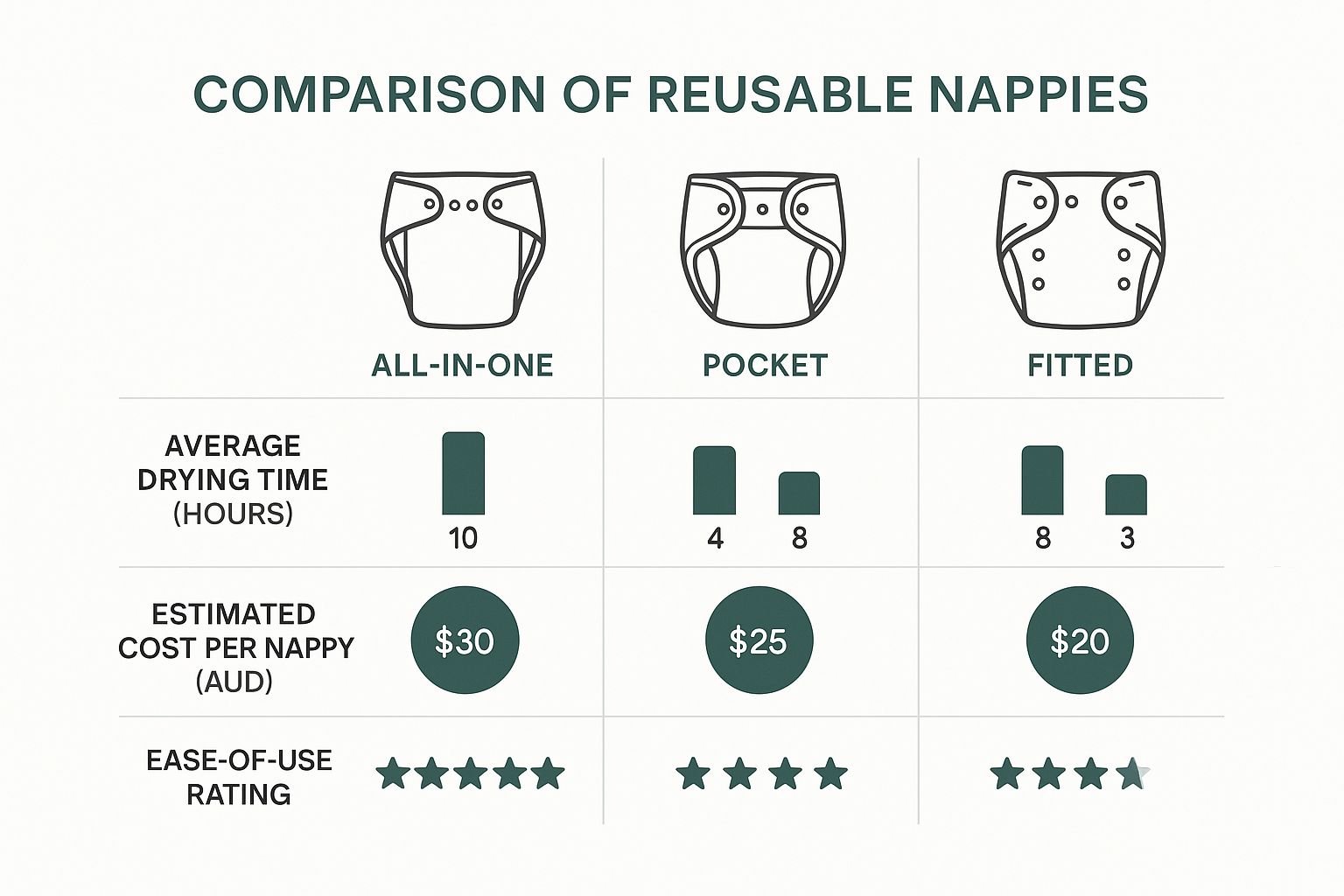
As you can see, there’s a clear trade-off between pure convenience and things like cost and how quickly they’ll be ready to use again—which is exactly why different styles work better for different families.
Fitted Nappies: The Night-Time Champion
Finally, we have Fitted Nappies. These are the unsung heroes of the cloth community, especially when it comes to getting a full night's sleep. A fitted nappy is made entirely of absorbent material—think of it as one giant, super-soaker shaped like a nappy. It has elastic at the waist and legs for a snug fit, but here’s the key difference: it has no waterproof layer.
Because it's not waterproof on its own, a fitted nappy needs a separate waterproof cover over the top. This might sound like more work, but this two-step system is what makes it so incredibly absorbent and virtually leak-proof. The entire nappy soaks up wetness, and the cover acts as the final foolproof barrier. This is why it’s the go-to solution for that long 10-12 hour stretch overnight. For a deeper dive into all nappy systems, you can explore this helpful guide to cloth, hybrid, and disposable nappies.
Like AIOs, fitted nappies are bulky and can take ages to dry. But for any parent who has battled with overnight leaks, their amazing performance is a total game-changer, giving you peace of mind that both baby and the cot will stay dry until morning.
Getting to Grips With Nappy Materials and Inserts
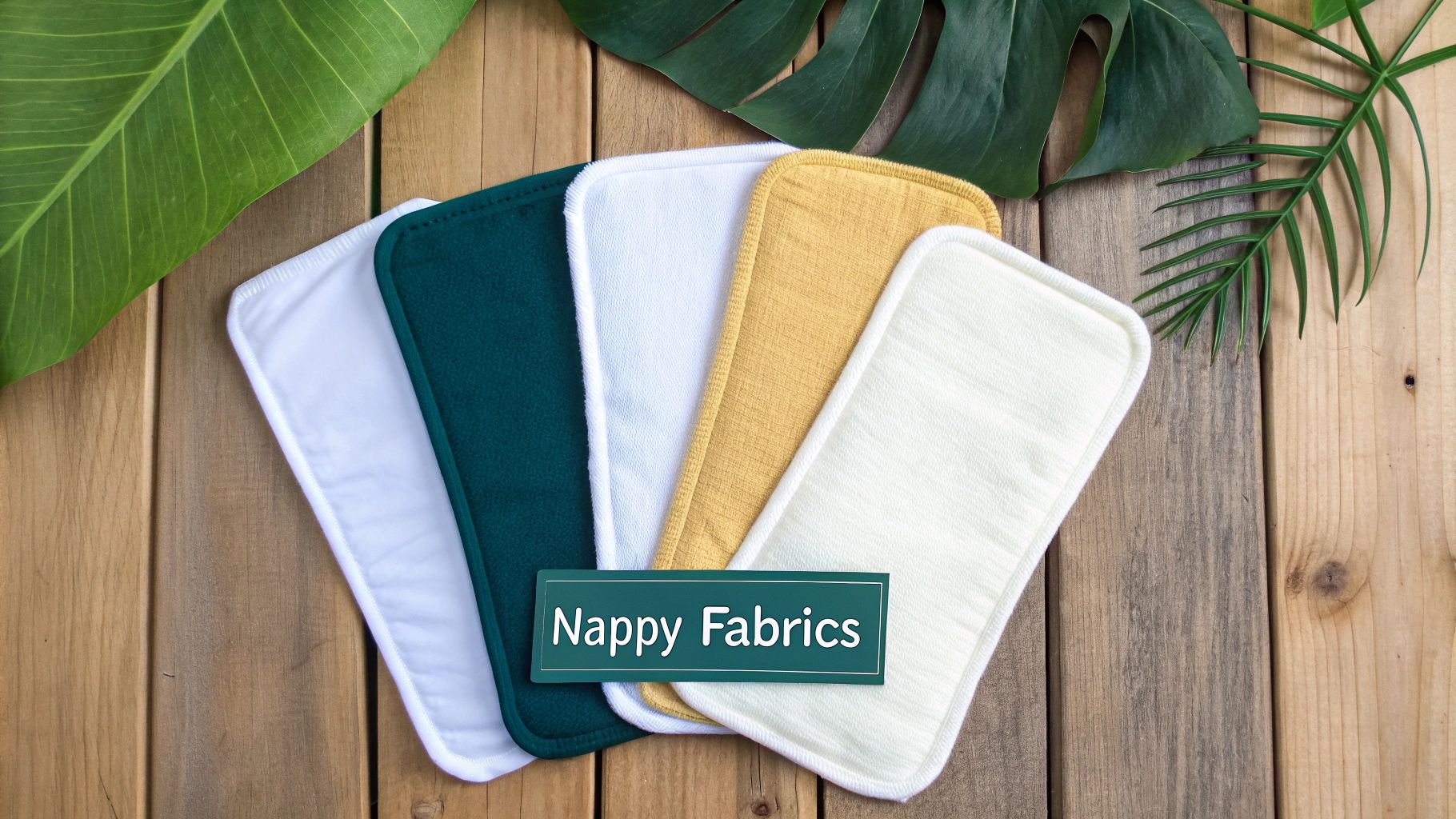
The real magic of a reusable nappy isn't just the pretty waterproof shell—it’s the absorbent core that does all the heavy lifting. Understanding what’s inside your nappy is the key to preventing leaks, keeping your baby comfy, and building a stash that actually works for your family.
Think of it this way: the outer shell is the car's body, but the inserts are the engine. One provides the structure, but the other delivers the power.
When you're searching for the best reusable nappies Australia has to offer, you’ll find that different fabrics have completely different personalities. Some absorb liquid in a flash, while others are slow and steady, capable of holding a huge amount for hours on end. Getting this combination right means fewer changes, drier nights, and a much happier bub.
Natural Fibres: Gentle and Super Thirsty
Natural fibres come from plants and are loved for their incredible absorbency and soft feel, which is a huge bonus for babies with sensitive skin. They're the marathon runners of the nappy world—they might take a moment to get going, but they have amazing staying power.
- Bamboo: Wonderfully soft and a real workhorse for absorbency. Bamboo holds a lot of liquid and even has some natural antibacterial properties. The only catch is it can be a bit slow on the uptake, so it often works best when paired with a faster-absorbing insert.
- Hemp: This is the undisputed king of absorbency. Hemp can hold a frankly astonishing amount of liquid, making it the go-to for overnight nappies or for those babies who are heavy wetters. On the flip side, it’s a very slow absorber and can feel a bit stiff until it's been washed a few times.
- Cotton: It's familiar, reliable, and just gets the job done. Cotton (especially organic) is breathable, soft, and absorbs at a good, moderate speed. It's a fantastic all-rounder and a solid foundation for any nappy stash.
Synthetic Fibres: Fast and Efficient
Synthetic fibres are man-made and engineered for pure performance. They're famous for their ability to wick moisture away quickly, leaving your baby’s skin feeling dry to the touch. The main synthetic you'll come across is microfibre.
Microfibre is like a sponge; it soaks up liquid incredibly fast. This makes it brilliant for preventing those "flooding" leaks that can happen when a baby does a big wee all at once.
The main drawback? Also like a sponge, it's prone to "compression leaks"—if the nappy gets squeezed (think a tight car seat strap), the liquid can be pushed right back out. It's also critical that microfibre is never placed directly against a baby’s skin, as it’s so effective at pulling away moisture that it can cause dryness and irritation. It’s designed to be tucked safely inside a pocket nappy.
Pro Tip: The secret to a truly leak-proof nappy is often in the combination. A popular strategy is to layer a fast-absorbing microfibre or cotton insert on top, with a super-thirsty bamboo or hemp insert underneath. This gives you the best of both worlds—quick absorption and massive capacity.
The Essential First Step: Prepping Your Inserts
So, you’ve bought your shiny new nappies and are ready to jump in, right? Hold on a second. New inserts, especially natural ones like hemp and cotton, are coated in natural plant oils that repel liquid. To get them working properly, they need to be "prepped."
Prepping just means washing and drying them a few times before you use them on your baby. This process strips away those oils and fluffs up the fibres, unlocking their true absorbency potential.
While synthetics like microfibre only need one quick wash, natural fibres might need 5-8 washes to hit their peak performance. Don't be tempted to skip this—it’s the difference between a frustratingly leaky nappy and a reliable one. Your washing machine does all the work, and you'll be rewarded with nappies that perform brilliantly from day one.
Creating a Simple and Effective Wash Routine
Okay, let's talk about the elephant in the room: the poo. For so many parents thinking about cloth, the whole idea of washing dirty nappies is the biggest hurdle. But I promise you, modern cloth nappy laundry is a world away from the old-school soaking and scrubbing you might be imagining.
Forget complicated potions and endless buckets. All you need is a simple, science-backed wash routine to get your nappies hygienically clean, smelling fresh, and ready for your little one.
The goal here is to set up a reliable system that fits in with your life and works with your Aussie washing machine. Once you get the hang of it, it just becomes another load of laundry in your weekly cycle.
First Things First: Dealing With Soiled Nappies
Before a nappy even sees the inside of your washing machine, you need to deal with any solids. This is the part that freaks most people out, but it’s surprisingly straightforward.
If your baby is exclusively breastfed, you're in luck! Their poo is 100% water-soluble. That means you don't have to do a thing. The nappy can go straight into your dry pail (which is just a laundry basket with good airflow), and the machine will wash it all away. Easy.
Once your baby starts eating solids, the game changes slightly. The poo needs to be plopped or scraped into the toilet before washing. A dedicated spatula (often called a 'poo scraper') or even just a bit of toilet paper does the trick. Many parents swear by installing a simple bidet-style hose to their toilet, known as a 'nappy sprayer', which makes rinsing clean a breeze.
The Proven Two-Step Wash Routine
The secret to sparkling clean nappies that don't smell is a two-step process: a short pre-wash followed by a long main wash. This method is absolutely key to making sure everything is properly flushed out and sanitised.
Step 1: The Daily Pre-Wash
Think of this first wash as the rinse cycle that gets rid of the worst of the mess.
- Gather: Every day or two, grab all your used nappies and inserts.
- Wash: Pop them in the machine for a short cycle, around 30-60 minutes. Use a half dose of a good quality detergent and warm water (40°C).
- Store: Once the cycle finishes, you can just leave the damp, pre-washed nappies in the machine or toss them back into your dry pail until you're ready for the main wash.
This pre-wash isn't optional—it's the most important step! It flushes away all the urine and poo residue so that your main wash uses fresh, clean water to do the heavy-duty sanitising.
Step 2: The Main Wash Every 2-3 Days
This is the cycle that deep-cleans your nappies and gets them truly pristine.
- Bulk It Out: Add your pre-washed nappies to the machine. For the best clean, you need good agitation, which means the machine drum should be about three-quarters full when loaded loosely. If you need to, top it up with other small items like baby clothes, tea towels, or socks.
- Add Detergent: Use a full dose of your detergent, following the packet instructions for a heavily soiled load.
- Wash Long and Hot: Choose the longest, most heavy-duty cycle your machine has—we're talking 2-3 hours. Use hot water (60°C) to effectively kill any lingering bacteria and blitz away residue.
This robust two-step routine is the cornerstone of success with the best reusable nappies Australia offers, keeping them absorbent and stink-free for years. If you want to dive deeper, these simple steps for getting your cloth nappies clean and bright are a fantastic resource.
Choosing the Right Detergent
Good news! You don't need a special, expensive "nappy wash". Your best bet is a strong, mainstream powder detergent from the supermarket that works well in your local water.
Here’s what to look for:
- Embrace enzymes: Detergents with enzymes are brilliant at breaking down organic matter, which is exactly what you need.
- Say no to fabric softener: This is a big one. Softeners coat the nappy fibres with a waxy film, which makes them repel liquid—the exact opposite of what you want!
- Avoid "eco" detergents (for nappies): While they have their place, plant-based and eco-friendly detergents often aren't powerful enough to handle the bio-load of nappies and can lead to smelly build-up issues down the track.
For more great advice on washing baby items safely, check out this guide on the dos and don'ts of washing baby clothes.
Drying Your Nappies
When it comes to drying, the Aussie sun is your secret weapon. Hanging nappies on the line is free, and the sun's UV rays are incredible for naturally bleaching away any faint stains and killing germs.
A quick tip: to protect the delicate elastics and the waterproof PUL layer on your nappy shells, hang them in the shade or on an airer inside. The absorbent inserts, on the other hand, are tough little things—they can be hung in direct sun or even tumble-dried on high heat to get them back in rotation faster.
With a simple routine like this, you'll find that managing cloth nappies quickly becomes just another easy load of laundry, not a chore to be feared.
The Real Cost: Reusables vs. Disposables
Does the initial price tag for a set of reusable nappies give you pause? It's a common feeling, but looking at that one-time cost is a bit like only seeing the first chapter of a book. It doesn't tell the whole story.
Think of it this way: buying disposables is like a subscription service you can't easily cancel. It’s a small, manageable cost each week, but it just keeps going... and going. Before you know it, you've spent a small fortune. Reusables are a one-off purchase. A bit of a sting at first, maybe, but once it's done, it's done.
When you look at the total cost over the two or three years your little one will be in nappies, it becomes clear which option is kinder to your family's budget. It's not just an eco-friendly choice; it's a seriously smart financial one.
Let's Crunch the Numbers
Let's get down to brass tacks. The average Aussie baby will go through roughly 6,000 disposable nappies before they're toilet trained. A single disposable can set you back anywhere from 30 cents for a budget brand to over 70 cents for a premium or eco-friendly option.
Here’s what that looks like over three years, using a conservative estimate:
- Disposable Nappies: At an average of $0.50 per nappy, the total bill for one child comes to about $3,000.
- Reusable Nappies: A complete set of 24-30 good-quality reusables usually costs between $800 and $1,200. This is a one-time investment designed to see you right through from newborn to toddler.
Even when you add in the cost of washing—water, power, and detergent—which is typically around $200-$300 over those three years, the savings are massive. You could easily be $1,500 to $2,000 better off per child.
The Hidden Financial Perks of Going Reusable
The savings don't just stop with your first baby. A well-looked-after set of modern cloth nappies is built to last. They can easily be passed down to your next child, and the one after that, which means your return on that initial investment just gets bigger and bigger.
The Australian reusable nappy scene is absolutely booming, with experts predicting a growth rate of around 10.6% each year between 2025 and 2035. This isn't just a niche trend; it's a movement driven by parents who've seen the huge cost savings and environmental benefits first-hand. You can check out more market insights on the growing cloth nappy trend to see just how popular they've become.
And there’s another financial bonus that many parents overlook: resale value.
That’s right—the pre-loved market for cloth nappies is thriving. If you've looked after them, you can often sell high-quality, popular brands for 30% to 50% of what you originally paid. This means you can get a good chunk of your money back once you’re finally done with the nappy phase.
When you add it all up—the direct savings on disposables, the free ride for baby number two (or three!), and the cash you can make back at the end—the financial case for reusable nappies is pretty hard to argue with. They truly are an investment that pays you back for years.
A Look at Some of Australia's Best Reusable Nappy Brands
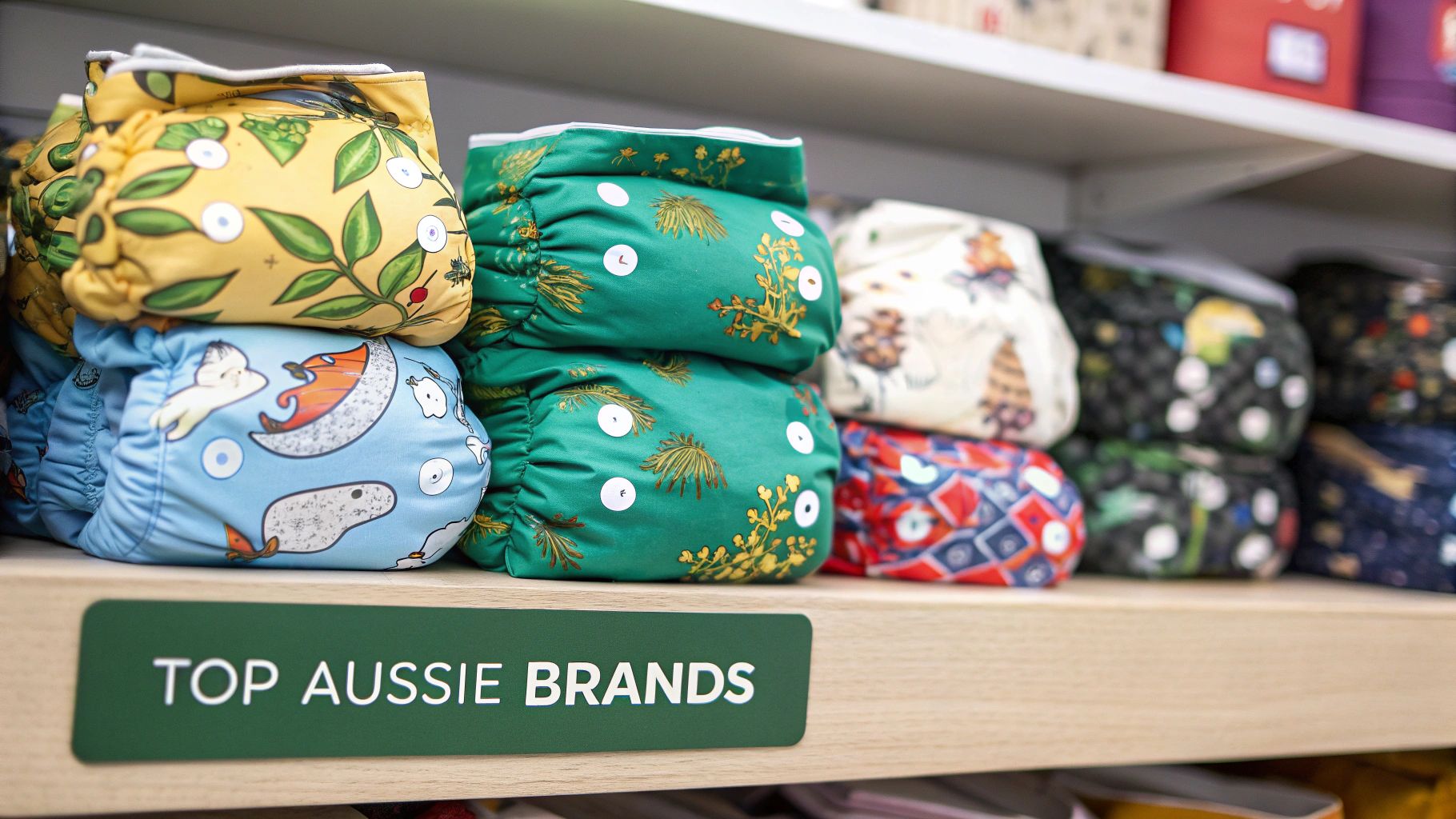
Okay, you've got the hang of the different styles, fabrics, and how the laundry works. Now for the really fun part – choosing your nappies! The Aussie cloth nappy scene is bursting with brilliant local brands, each with its own unique flavour.
Instead of overwhelming you with a massive list, I’ll walk you through a few types of brands you'll find. Think of this as your starting point to discover companies that really click with what's important to you. Whether you’re all about gorgeous prints, focused on organic materials, trying to stick to a budget, or just desperate for a leak-proof night, there’s an Aussie brand out there for you and your little one.
For the Style-Conscious Parent
Let's be honest, sometimes you just want something beautiful. If you see nappies as another adorable outfit, you'll love the brands known for their stunning, artist-commissioned prints. They often drop limited-edition collections that are snapped up in minutes, turning a humble nappy into a little piece of art.
These brands tend to focus on premium fabrics and a nice, trim fit that doesn’t look bulky under clothes. They’re a fantastic choice if you love unique designs and want a nappy that’s as gorgeous as it is effective.
For the Eco and Skin-Focused Family
If natural, gentle fibres are your top priority, keep an eye out for brands that champion materials like GOTS-certified organic cotton or buttery-soft bamboo velour. These companies are all about making nappies that are kind to the planet and even kinder to sensitive baby skin.
Their whole philosophy is usually built around ethical manufacturing and a low environmental footprint, right from the farm to your change table. When you choose one of these brands, you’re not just getting a super-soft nappy; you’re backing a business with serious eco-credentials.
The right brand isn't just about the product itself; it's about finding a company whose values and priorities mirror your own. From artistic expression to ethical sourcing, the Australian market offers a perfect match for every family.
For Bulletproof Overnight Performance
Sick of waking up to wet sheets? Some Aussie brands have made it their mission to solve this exact problem, earning a reputation for their bomb-proof night nappies. They specialise in ultra-thirsty fitted nappies, often using powerhouse fabrics like hemp or bamboo fleece, designed to last a solid 10-12 hours.
These are the brands that parents of heavy wetters swear by. The nappies might be a bit bulkier, but the peace of mind they offer is priceless. When you're searching for the best reusable nappies Australia has for overnight use, these specialists are where you should look first.
For the Budget-Savvy Starter
Jumping into cloth nappies doesn't need to cost a fortune. You'll find several fantastic Australian brands that deliver reliable, high-quality nappies at a much friendlier price. They focus on simple, durable designs and often have great-value bulk packs that make it easy to build your collection.
These brands are perfect for families wanting to go full-time with cloth without a huge upfront cost. They're proof that you can save thousands in the long run without having to compromise on quality or performance.
Your Top Reusable Nappy Questions Answered
Diving into the world of cloth nappies is exciting, but let's be honest, it also brings up a lot of questions. It's totally normal to wonder about the nitty-gritty, day-to-day stuff. We've been there!
This section is all about giving you clear, straightforward answers to those final queries. Think of it as a chat with a friend who’s already figured it all out, so you can feel confident and ready to go.
How Many Reusable Nappies Do I Actually Need?
This is the big one, isn't it? For full-time cloth nappy use, you’ll find that a stash of 24 to 30 nappies is the sweet spot. This gives you enough to get through a couple of days before you need to do a wash, without ever feeling like you're about to run out.
With a newborn, you might want to lean towards the higher end of that number, as they go through nappies at a startling rate! A decent-sized stash means less washing stress and always having a clean, dry nappy on hand.
Can I Use Reusable Nappies When Out and About?
Absolutely! Taking your cloth nappies on the road is surprisingly simple. The secret weapon? A good wet bag. These are just waterproof, zippered bags designed to safely store used nappies until you get home.
Wet bags are brilliant because they lock in moisture and smells. You just pop the dirty nappy in, zip it up, and toss it in your nappy bag. It’s honestly just as easy as bagging up a disposable.
A little secret from experienced parents: modern cloth nappies, when fitted well, are often more reliable against leaks than disposables. Those snug leg elastics are fantastic at containing the dreaded "poonami" that disposables so often fail to hold back.
What About Nappy Creams?
You can definitely use nappy creams, but you just need to be a little savvy about which ones you choose. The thick, zinc or petroleum-based creams can create a waterproof barrier on the nappy fabric itself, which is the last thing you want! This build-up causes liquids to repel, leading to frustrating leaks.
The trick is to stick with cloth-safe creams made from natural ingredients like coconut oil or shea butter. If your baby's skin needs something a bit more heavy-duty, just pop a reusable or disposable liner in the nappy first. This protects the fabric while still giving your baby's bottom the protection it needs. To get the full picture, check out our guide on how to safely use nappy creams with your cloth nappies and keep them working perfectly.
Do I Have to Use Them All the Time?
Not at all! This isn't an all-or-nothing game. Plenty of Australian families find a happy balance using cloth nappies part-time. A really popular approach is to use reusables at home and switch to disposables for daycare, overnight sleeps, or when you're travelling.
This hybrid method still makes a huge difference. You'll significantly cut down on your household waste and save a lot of money. Remember, even using one reusable nappy a day keeps 365 disposables out of landfill each year. Every single one counts!
Ready to build your perfect starter kit or find eco-friendly essentials for your little one? Hello Charlie has everything you need, from top-rated nappies to natural skincare, all carefully vetted for safety and sustainability. Explore our curated collections at https://www.hellocharlie.com.au and make the switch with confidence.
Article created using Outrank


