

Safe baby essentials: non-toxic and eco choices for Aussie parents
, by Hello Charlie, 12 min reading time
Navigate Australian safety standards and eco certifications to choose safe, non-toxic baby essentials. Your practical guide to nappies, toys, and nursery gear.
, by Hello Charlie, 12 min reading time
Standing in a baby products aisle, or scrolling through an online marketplace at midnight, the sheer number of options can feel overwhelming. Every label promises “natural”, “safe”, and “gentle” but without knowing what those words actually mean, it is hard to tell a genuinely tested product from clever marketing. Australian parents face a real challenge: a flood of cheap imports, vague eco claims, and a marketplace that does not always put your baby first. This guide walks you through the key standards, the best eco choices, and how to verify what you are buying, so you can stock your nursery with confidence.
| Point | Details |
|---|---|
| Prioritise local standards | Always choose baby products with AS/NZS codes and independent CHOICE testing for safety assurance. |
| Eco is not always safer | Look for third-party verified eco essentials, not just brand labels, to avoid greenwashing. |
| Avoid risky imports | Marketplace products commonly fail Australian safety tests; buy from trusted local retailers instead. |
| Proper care is essential | Maintain hygiene and lifespan by following safe storage and washing routines for all baby items. |
Australia has some of the most robust consumer product safety regulations in the world, but they only protect your family if you know how to use them. The Australian Competition and Consumer Commission (ACCC) monitors product recalls and mandatory safety standards, while CHOICE conducts independent testing across hundreds of baby products each year. Together, they form a solid foundation for informed buying.
When you pick up a baby product, look for AS/NZS standard codes on the packaging. These codes indicate the product has been designed or tested against an Australian and New Zealand safety benchmark. For example, cot mattresses should meet AS/NZS 8811.1:2013. CHOICE advises parents to prioritise firm, flat sleep surfaces meeting this standard to reduce the risk of sudden unexpected death in infancy (SUDI). Soft, inclined, or heavily padded sleep surfaces pose a genuine danger and no amount of good branding changes that.
The danger with online marketplaces is that imported products often bypass these checks entirely. A product sold on Temu or AliExpress may display logos that look official but carry no legal weight in Australia. Mandatory safety standards apply to suppliers, but enforcement for overseas sellers operating through third-party platforms is notoriously difficult. This is not a small risk. It is a structural gap in the marketplace that catches many parents off guard.
Safety warning: Never place a baby on a soft, inclined, or padded sleep surface, regardless of how a product is marketed. Only surfaces meeting AS/NZS 8811.1:2013 should be used for infant sleep.
Use this checklist before buying any baby essential:
| Safety source | What it does | How to access |
|---|---|---|
| ACCC recalls | Lists dangerous products withdrawn from sale | productsafety.gov.au |
| AS/NZS codes | Sets design and performance benchmarks | Listed on compliant packaging |
| CHOICE testing | Independent lab tests on real products | choice.com.au |
| Hello Charlie | Curated tested eco products | hellocharlie.com.au |
For more on keeping products safe once they arrive home, our safe storage advice covers the essentials.
With safety standards in mind, let us look at baby care products, starting with eco-friendly nappies, wipes, and cleaners. This is often where eco-conscious parents invest the most energy, and for good reason. A baby goes through thousands of nappies in their first two years, so the environmental and health impact adds up quickly.
The two main choices are reusable cloth nappies and eco-disposables. Reusable cloth nappies like EcoNaps score 65% in CHOICE tests, with absorbency rated at 59%, and they outperform many conventional disposables for sustainability, though performance varies between brands. Eco-disposables, on the other hand, offer convenience but should be chlorine-free and ideally certified by a recognised third-party body such as the Nordic Swan or FSC.
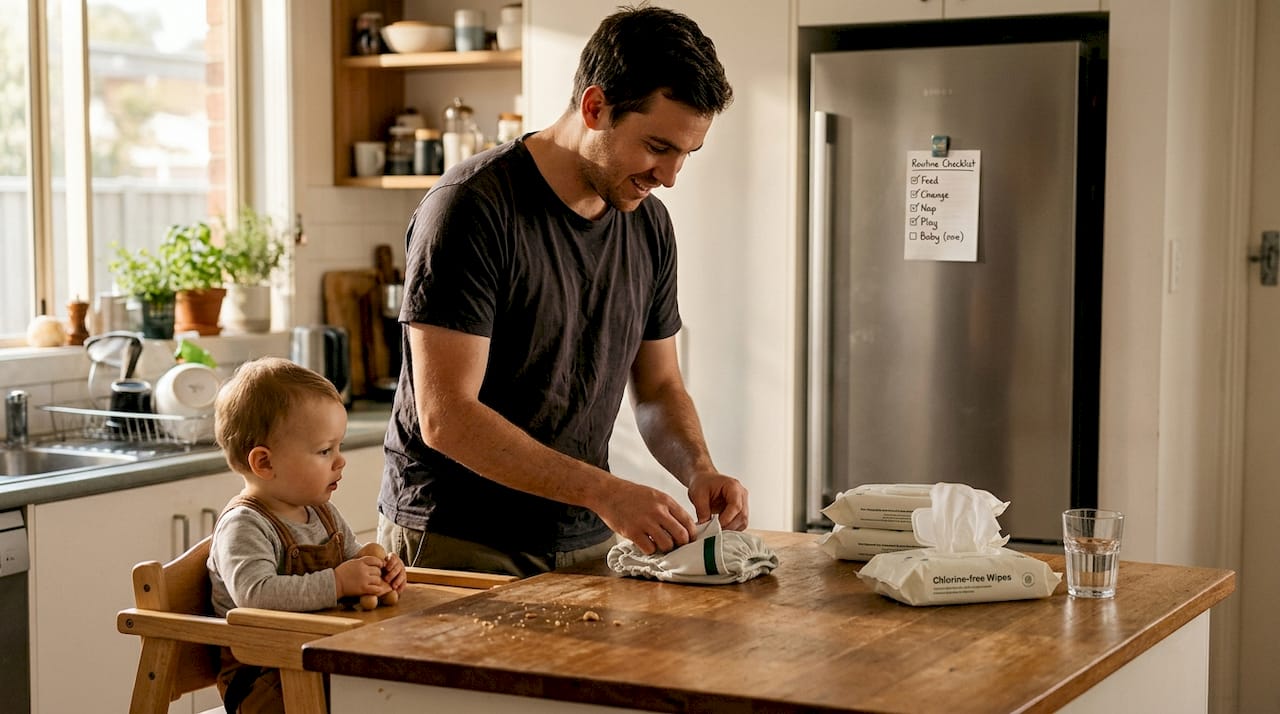
The word “eco” on a packet tells you almost nothing by itself. A genuinely eco-friendly nappy or wipe will list its certifications clearly, disclose its ingredients, and ideally carry evidence of third-party testing. Greenwashing is rife in this category, so check the reusable options available and look beyond the branding.
Pro Tip: When assessing a wipe or cleaning product, flip it over and read the ingredient list. If it contains fragrance (listed as “parfum”), parabens, or phthalates, put it back. These ingredients have no place near infant skin.
Ingredients to avoid in nappies, wipes, and baby cleaners:
For a broader look at reducing household waste through smart product choices, our zero waste tips and recyclable products guide are both worth bookmarking.
Next, let us ensure that playtime and sleep environments are both safe and sustainable. Toys and nursery gear carry risks that are less obvious than a sharp corner or a loose button. Chemical hazards in plastics and paints, and mechanical hazards like small detachable parts, are the ones most likely to be overlooked during a quick online shop.
CHOICE investigations found that toys from Temu and AliExpress failed safety tests at alarming rates, with 6 out of 22 tested toys presenting choking hazards. Compliance with AS/NZS ISO 8124.1 is mandatory in Australia, but the ACCC has no pre-market checking system, meaning non-compliant products can reach consumers before any action is taken.
Here is how to check toys and nursery equipment before you buy:
Expert warning: There are no pre-market safety checks for toys sold through online marketplaces in Australia. Once a dangerous product is identified, it may already be in thousands of homes. The only reliable safeguard is buying from established Australian retailers who take compliance seriously.
Sustainable nursery choices worth prioritising include solid timber toys with non-toxic finishes, certified organic cotton swaddles and bedding, and nursery furniture made from low-VOC (volatile organic compound) materials. Cheap plastic toys may seem harmless, but some contain BPA or phthalates, particularly if they are imported without verifiable testing.
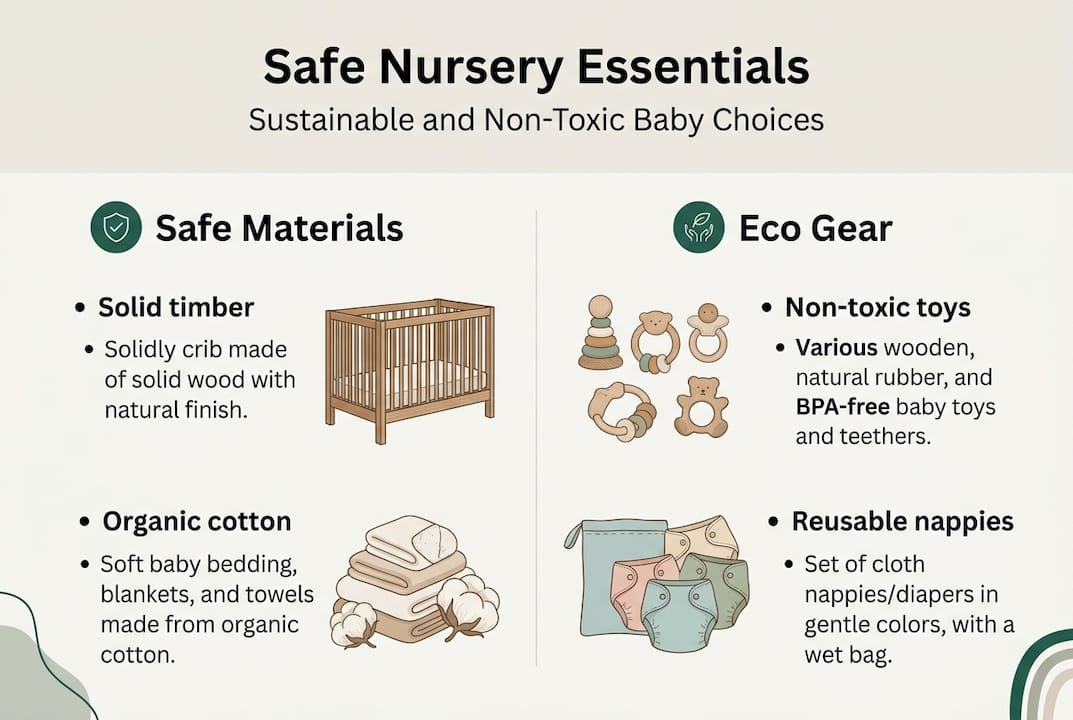
Browse trusted Australian baby gear and read through product reviews from other Australian parents before committing to a purchase.
Safe use is not just about buying the right things. Daily care and maintenance matter just as much. A reusable nappy stored incorrectly, or a toy cleaned with the wrong product, can become a hazard over time.
When it comes to washing reusables, the rules are simple but important. Reusable nappies and wipes cut waste and plastics significantly, but they require proper washing without softeners or bleach to maintain their performance and safety. CHOICE rewet scores favour reusables for skin contact when they are laundered correctly, meaning the fabric stays drier against baby’s skin over time.
Pro Tip: Store dry-pailed cloth nappies in a well-ventilated container away from direct sunlight. This prevents mould growth and preserves the absorbent fibres for longer. Air drying in sunlight is a natural sanitiser and extends the lifespan of most reusable items.
Maintenance routines by product type:
Proper storage means keeping products away from moisture, extreme heat, and direct sunlight. Many chemical-based products degrade when stored in hot cars or garages, and natural rubber items can crack if left in sunlight. Our storage advice goes deeper on this, and for general upkeep ideas, the hygiene tips section covers everyday routines.
Here is something worth saying plainly after years of working in sustainable baby retail: the most dangerous products we see are not the ones that look dodgy. They are the ones that look trustworthy.
A beautifully packaged toy from an overseas brand with a pastel logo and “non-toxic” printed in a calming font can still fail Australian safety standards. Global certifications do not automatically translate to local compliance. A CE mark, for example, signals European conformity but carries no legal weight under Australian consumer law.
The ACCC and CHOICE testing consistently show that cheap online imports fail mechanical and chemical tests at high rates. But it is not just the budget options. Even well-known “eco” brands from overseas should be verified against Australian standards before you trust them with your baby. As CHOICE’s buying guide for baby furniture notes, no pre-market checks exist for marketplace products, so the responsibility falls to the retailer and ultimately to you.
This is why we believe the smartest approach is not to follow brand aesthetics or global trends. It is to anchor every purchase decision in Australian third-party testing, ACCC compliance data, and retailers who do the vetting work before products reach your door. Browse our accredited eco essentials for options that have already passed that bar.
If this guide has made one thing clear, it is that great choices come from knowing what to look for, not just what looks good. Hello Charlie takes that responsibility seriously, curating every product against Australian safety standards and eco credentials so you do not have to start from scratch.
Whether you are building your newborn kit or replacing something that did not make the cut, our range covers everything from an eco newborn bundle to non-toxic baby wipes verified for sensitive skin. Every product we stock goes through a careful selection process with a focus on safety, sustainability, and genuine eco credentials. Start exploring our full range of organic and eco essentials and shop with confidence knowing that the hard work of vetting has already been done.
Look for AS/NZS codes on the packaging, check CHOICE test results for that specific product, and always search the ACCC recall database before purchasing. Firm, flat sleep surfaces meeting AS/NZS 8811.1:2013 are one important example of what standards-compliant looks like in practice.
Not necessarily. The word “eco” alone is not regulated, so look for chlorine-free labelling and independent certification from recognised bodies. EcoNaps score 65% in CHOICE tests, showing that even good products vary, and third-party verification is always more reliable than a brand claim.
Yes. Imported goods from Temu, AliExpress, and similar platforms fail safety tests at high rates, with no pre-market checks in Australia to catch unsafe products before they reach your home. Established Australian retailers offer far greater accountability.
Yes. Proper washing of reusables means avoiding bleach and fabric softeners, using moderate temperatures between 40 and 60°C, and air drying to preserve absorbency and minimise chemical residue on fabric.