
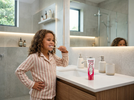
When Should Toddlers Start Using Fluoride Toothpaste in Australia?
, by Hello Charlie Blogs, 16 min reading time
, by Hello Charlie Blogs, 16 min reading time
The first little tooth appears, you buy a tiny toothbrush — and then the toothpaste aisle makes a simple routine unexpectedly complicated. Fluoride-free, low fluoride, children's toothpaste, natural toothpaste, adult strength: which one is actually appropriate for a toddler?
In Australia, the general guidance is fairly straightforward. Brushing starts when teeth appear, but toothpaste usually does not. Until around 18 months, children generally brush with water only unless a dental professional recommends otherwise. From around 18 months, fluoride toothpaste becomes part of the routine.
The details matter, though. Fluoride concentration, the amount placed on the brush, your child's individual risk of tooth decay and even your household drinking water can affect the decision. So rather than treating fluoride as something simply to seek out or avoid, it is more useful to understand what your child needs at their particular age.
For most Australian children, toothpaste is generally introduced from around 18 months of age.
The Australian Dental Association's consumer guidance recommends:
Australian guidance is not completely identical in how it describes the amount of toothpaste. Queensland Health's current clinical guideline recommends a pea-sized amount of toothpaste containing 500–550 ppm fluoride for children aged 18 months to 5 years.
The practical takeaway is not to cover a toddler's entire toothbrush with toothpaste. Use only a small amount and follow the directions on the toothpaste you are using, together with any individual advice from your child's dental professional.
Fluoride is used in toothpaste because it helps strengthen tooth enamel and protect against tooth decay.
That matters because baby teeth are not simply temporary placeholders. They help children chew, speak and maintain space for developing adult teeth. Tooth decay in young children can cause pain and may require treatment that is much better prevented where possible.
Younger children are also more likely than adults to swallow some toothpaste while they are learning to brush and spit. That is why age, fluoride concentration and the amount placed on the toothbrush all matter.
Use: a soft child-sized toothbrush and water.
Focus on: establishing twice-daily brushing and making the routine familiar.
Exception: follow your dental professional's advice if your child has particular tooth-decay risk factors.
Use: an age-appropriate children's fluoride toothpaste.
Fluoride: Australian general guidance commonly refers to around 500–550 ppm fluoride for this age group.
Amount: only a small amount. Exact guidance varies between a smear and pea-sized amount, so follow the product directions and your dental professional's advice.
Use: standard-strength fluoride toothpaste unless a dental professional recommends something different.
Still important: many children continue to need help brushing effectively.
Don't self-prescribe: a dentist may recommend a different fluoride concentration or routine.
This may be relevant for children who already have signs of decay or who have limited exposure to fluoridated drinking water.

One thing Australian guidance agrees on is that young children need much less toothpaste than adults.
The Australian Dental Association currently recommends a smear of children's fluoride toothpaste for children aged 18 months to 6 years. Queensland Health's current clinical guideline uses the term pea-sized amount for children aged 18 months to 5 years.
This slight variation is a useful reminder that parents do not need to obsess over creating a mathematically exact blob. The important point is to use a small amount, supervise brushing and follow the instructions on the product you are actually using.
A toothbrush covered end-to-end with toothpaste might look familiar from advertising, but it is not necessary for a toddler.
Fluoride-free children's toothpaste remains widely available, particularly among products marketed as natural or designed for very young children.
But “fluoride-free”, “natural” and “safe if swallowed” answer different questions from “does this provide fluoride protection against tooth decay?”
Before around 18 months, Australian general guidance already recommends brushing with water rather than routinely using toothpaste.
From around 18 months, general Australian dental guidance moves towards children's fluoride toothpaste because fluoride provides an established anti-decay benefit.
That does not mean a fluoride-free toothpaste is automatically a poor product. Some families deliberately choose fluoride-free formulas, some children strongly dislike conventional toothpaste flavours, and individual dental advice can vary.
It does mean that fluoride-free should be understood as a trade-off or preference, rather than automatically treated as a sign that a toothpaste is better for children.
It can form part of the overall picture.
Many Australian communities have fluoride added to reticulated drinking water to help reduce tooth decay, but not every household receives the same water supply.
Families using rainwater tanks, private supplies, bottled water or filtration systems that remove fluoride may have different overall fluoride exposure.
If your household mainly uses non-fluoridated water, mention it when your child sees their dentist. It is useful information when assessing individual tooth-decay risk and deciding whether standard age-based toothpaste advice needs to be adjusted.
You do not need to become a toothpaste chemist. For most families, a few practical checks tell you far more than the claims on the front of the tube.
Do not assume every toothpaste with children's branding is designed for every age. Check the manufacturer's stated age suitability and directions.
Look for the fluoride level in ppm rather than relying on the words “kids”, “natural” or “gentle”. Australian general guidance commonly refers to around 500–550 ppm for younger children.
Check the recommended amount, age range and whether the manufacturer gives specific instructions about supervision, spitting or rinsing.
The theoretically ideal toothpaste is not very useful if its flavour turns brushing into a twice-daily battle. A child-friendly flavour can make consistent brushing much easier.
Words such as “natural”, “clean”, “organic” or “fluoride-free” do not tell you whether the product matches the fluoride recommendation for your child's age.
Fluoride is important, but it is not the only ingredient worth checking. Flavour, foaming agents, sweeteners and other formulation choices can also affect whether a toothpaste suits your family.
Children's toothpaste discussions often turn into two camps: fluoride versus fluoride-free.
We think that misses the more useful question:
What does this particular child need at this particular age?
A baby with their first two teeth, a two-year-old drinking fluoridated tap water and a five-year-old with early tooth decay living on tank water are not necessarily identical toothpaste decisions.
This is also why we would not choose toothpaste by one marketing word alone. “Natural” can tell you something about how a product is formulated, but it does not replace age guidance, fluoride concentration, brushing technique or individual dental advice.
At Hello Charlie, ingredient lists matter to us. But so does whether a product actually performs the job parents are buying it to do. For toothpaste, protecting teeth from decay belongs in that assessment too.
Once you understand the fluoride question, this is where choosing toothpaste becomes much easier.
We do not think there is one toothpaste that is automatically “best” for every child. We would choose based on age, fluoride preference or dental advice, flavour tolerance and the overall formulation.
If a family is deliberately choosing a fluoride-free toothpaste, this is one of the formulas we prefer in our current range.
It has a relatively simple xylitol-based formula, is SLS-free, Australian made and has no strong mint or fruit flavour — useful for children who strongly resist flavoured toothpaste.
The important consideration: it contains no fluoride. For most children from around 18 months, that differs from routine Australian public dental guidance recommending fluoride toothpaste.
View Jack N' Jill Flavour FreeFor families who want fluoride protection while still preferring a child-friendly Jack N' Jill formula, the Strawberry with Fluoride option is now part of our range.
It contains 1000 ppm fluoride, 40% xylitol, no SLS and a mild strawberry flavour rather than mint.
There is an important distinction: 1000 ppm is higher than the approximately 500–550 ppm concentration commonly described in Australian general guidance for younger children. The Jack N' Jill product directions specify a smear-sized amount for children aged 18 months to 6 years.
For a younger child, we would therefore recommend reading the directions carefully and discussing the fluoride concentration with your dental professional if you are unsure, rather than assuming every fluoride toothpaste is interchangeable.
View Jack N' Jill Strawberry with FluorideWhat we like about Jack N' Jill generally is not simply that it is positioned as a “natural” children's oral-care brand. The formulas are clearly disclosed, the flavours are designed with children in mind, and there are now both fluoride and fluoride-free options — which makes it easier for families to choose according to their own needs rather than treating one formulation philosophy as right for everyone.
We have already done a much deeper comparison in our 2026 Baby & Kids Toothpaste Cheat Sheet.
There we compare current formulas side by side, including fluoride levels, ingredient profiles, age recommendations and what we like — as well as the trade-offs we think parents should know about.
If you would rather browse first, you can also see our current children's toothbrushes, toothpaste and oral-care essentials in one place.
Compare Kids Toothpastes Shop Baby & Kids Oral CareBefore buying the next tube, check:
The aim is not to find the toothpaste with the longest list of claims. It is to find an age-appropriate product your child will actually use consistently as part of a good brushing routine.
For most Australian children under around 18 months, general guidance recommends brushing with a soft toothbrush and water rather than routinely using toothpaste. Follow your dental professional's advice if your child has specific tooth-decay risk factors.
Australian general guidance recommends introducing a children's fluoride toothpaste from around 18 months. The Australian Dental Association describes a children's toothpaste containing around 500 ppm fluoride for children under 6, while Queensland Health refers to 500–550 ppm for children aged 18 months to 5 years.
Australian guidance varies slightly. The Australian Dental Association recommends a smear for children aged 18 months to 6 years, while Queensland Health's clinical guideline refers to a pea-sized amount for children aged 18 months to 5 years. Use only a small amount and follow the directions on your toothpaste and any advice from your child's dentist.
Young children commonly swallow some toothpaste while learning to brush. That is one reason only a small quantity should be used and brushing should be supervised. If you are concerned about how much your child is swallowing or about the fluoride concentration of their toothpaste, discuss it with your dentist.
Not automatically. Fluoride-free toothpaste may suit a deliberate family preference or particular circumstances, but from around 18 months Australian general dental guidance recommends fluoride toothpaste because fluoride helps protect against tooth decay.
Australian Dental Association guidance generally recommends standard-strength fluoride toothpaste from around 6 years of age, unless a dental professional recommends something different.
Fluoride levels vary. Rainwater and private water supplies do not necessarily provide the fluoride found in fluoridated municipal supplies. If your household mainly relies on tank water, mention this at your child's dental appointment.
Follow the manufacturer's directions and consider asking your dental professional if you are unsure. General Australian guidance commonly describes lower-fluoride children's toothpaste for children under 6, but individual products and dental recommendations can differ.
This article provides general Australian oral-health information rather than individual dental advice. Children with existing tooth decay, developmental needs, unusual fluoride exposure or other individual risk factors may receive different recommendations from their dental professional.