
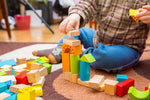
Why Simple Toys Help Babies Learn Through Play
, by Hello Charlie Blogs, 5 min reading time
, by Hello Charlie Blogs, 5 min reading time
It is easy to feel like your baby needs the newest, brightest, most “educational” toy.
Walk into a toy aisle and you will see flashing lights, buttons, songs, talking animals, apps and clever claims about learning. But babies and toddlers do not always need more stimulation. Often, they need less.
Simple toys can be some of the best toys for early learning because they leave room for your child to explore, repeat, imagine and solve problems in their own way.
At Hello Charlie, we love toys that are practical, safe, lower-tox and genuinely useful. You can browse our Eco Baby Toys, Eco-Friendly Toys and Learning Toys collections if you are choosing toys that support open-ended play.
Simple toys are toys that do not do all the work for your child.
They do not need batteries, screens or complicated instructions. They do not tell your child exactly what to press, say or repeat. Instead, they invite your child to explore.
Simple toys may include:
These toys can be used in many different ways. A block can be a tower, a phone, a bridge, food in a pretend kitchen, or a road for a car. That flexibility is the point.
Simple toys encourage active play.
Instead of watching a toy perform, your child has to do something with it. They pick it up, turn it over, bang it, stack it, drop it, hide it, mouth it, pass it to you and try again.
That kind of repeated exploration helps babies and toddlers learn about cause and effect, movement, sound, texture, balance and problem-solving.
The American Academy of Pediatrics clinical report on toys and child development highlights the value of toys that support caregiver interaction, language, pretending, problem-solving and creativity.
When a baby tries to stack two blocks and they fall over, that is learning.
When a toddler works out that a round shape fits into a round hole, that is learning.
When a child tries a puzzle piece one way, then turns it around and tries again, that is learning too.
Good toys do not always need to give instant answers. Sometimes the best toys give children space to test, repeat and work things out.
Electronic toys often have one main function. Press a button and the toy sings. Press another button and it flashes. The toy is leading the play.
Open-ended toys are different. Your child leads the play.
A basket of wooden blocks might become a zoo, a farm, a city, a birthday cake or a very serious toddler construction site. The same toy can change depending on your child’s age, mood and imagination.
You can explore open-ended options in our Building Toys, Pretend Play and Puzzles & Games collections.
The toy itself is only part of the story.
The most important part is often what happens between you and your child while playing.
When you sit nearby and talk about what your baby is doing, you add language to the play. You might say:
Raising Children Network explains that talking, exploring and playing together helps babies learn and understand the world while feeling safe and secure.
Not always.
Some electronic toys can be fun. A musical toy, light-up toy or sound toy can have a place in your child’s playroom. The issue is balance.
If a toy does most of the talking, singing, moving and deciding, your child may have fewer chances to lead the play. For babies and toddlers, interaction with people is far more valuable than a toy that performs on its own.
A helpful rule is to ask: does this toy invite my child to do something, or does it mostly ask my child to watch?
Fewer than most of us think.
Too many toys out at once can make it harder for children to focus. A small selection of well-chosen toys can lead to deeper, calmer play.
Try rotating toys instead of keeping everything out. Put a few toys in a basket and store the rest away. After a week or two, swap them over. Old toys often feel new again after a break.
When choosing toys for babies and toddlers, look for:
At Hello Charlie, we prefer toys made from thoughtful materials such as responsibly sourced wood, organic cotton, natural rubber and food-grade silicone where appropriate. You can browse our full Eco-Friendly Toys collection for more ideas.
Browse newborn toys for 0–6 months.
Browse toys for 6–12 months.
Browse toys for 12–18 months and toys for 18–24 months.
Browse toys for 2–3 years and toys for 3+ years.
Simple toys do not need flashy claims to be valuable.
A well-made block, puzzle, rattle or stacking toy can support problem-solving, creativity, language, movement and connection. The toy matters, but the way your child plays with it matters even more.
The best toys leave room for your child’s ideas.
For more thoughtful toy ideas, browse our Eco Baby Toys, Learning Toys, Building Toys and Pretend Play collections, or read more guides on the Hello Charlie Blog.